

If you’ve spent any time on LinkedIn lately, you’ve seen the alphabet soup. SEO. AEO. GEO. AIO. SXO. Every week someone announces that SEO is dead and that you need to panic-buy the new acronym.
Here’s the good news: SEO isn’t dead. It’s just grown some new floors.
Search used to be simple. Someone typed a question into Google, Google showed ten blue links, and you fought to be number one. Now people ask ChatGPT. They read an AI summary at the top of Google before they see a single link. They talk to their phones while cooking dinner. And when they finally land on your website, they’ve got about three seconds to decide whether you’re worth their time.
That’s a lot of places to show up. So let’s break it down, with no jargon and no panic.
What’s Actually Changed in Search
Before we get into the layers, it helps to understand why they exist. Three shifts are driving all of this.
1. Fewer clicks. SparkToro’s 2026 study of US search behaviour found that 68.01% of Google searches ended without a click, up from 60.45% in 2024. Put another way, for every 1,000 US Google searches, only about 276 clicks now reach the open web, down from 374 in 2024. The click is still valuable. There are just fewer of them to go around.
2. AI answers. Pew Research tracked the browsing of 900 US adults and found that when Google showed an AI summary, people clicked a regular result link in 8% of visits, compared with 15% when there was no summary. Only 1% of visits included a click on a link inside the AI summary itself.
3. Search is happening everywhere. ChatGPT reported 900 million weekly active users in early 2026, roughly double the year before. Similarweb’s data shows visits across generative AI platforms growing 70% year on year. And it’s not one tool: ChatGPT’s share of AI chatbot web traffic fell from about 79% in May 2025 to about 54% in May 2026 as Gemini and others grew.
None of this means search stopped mattering. It means search now has more surfaces, and each one rewards something slightly different. That’s the five layers.
The Five Layers at a Glance
Think of these like floors in a building. You can’t build the top floor without the ground floor, but you also don’t want to stop at the ground floor and call it a skyscraper.
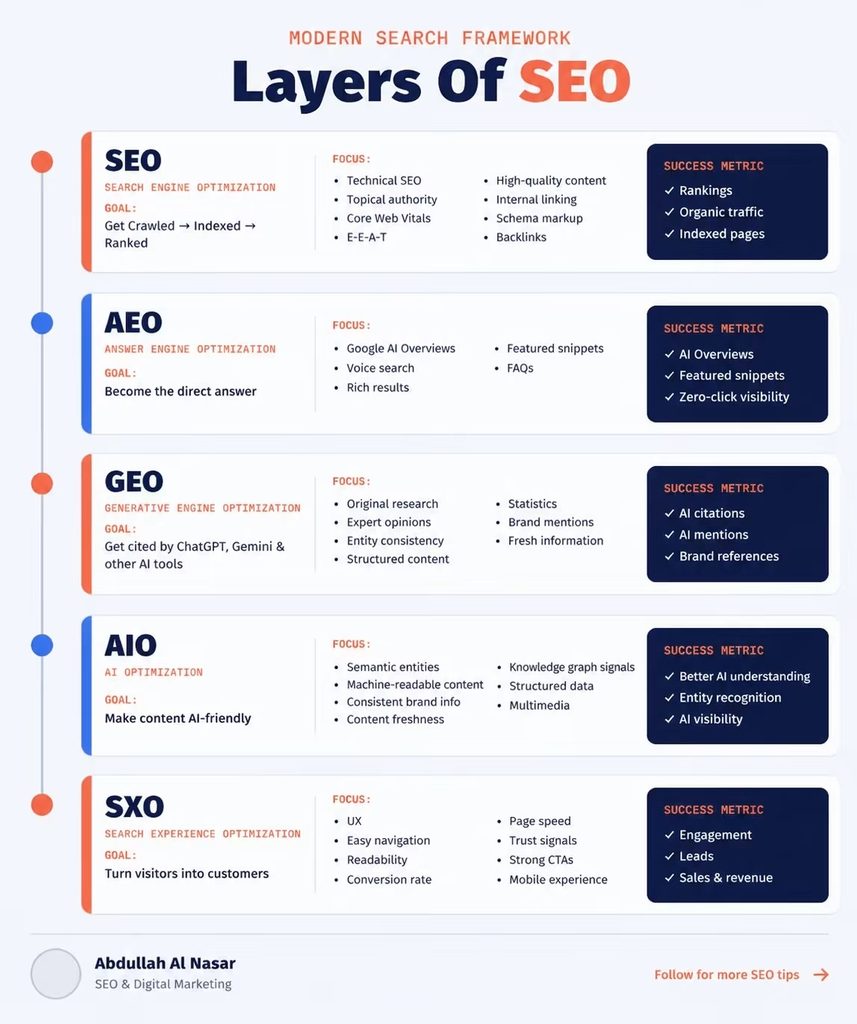
| Layer | Stands for | The goal | Success looks like |
|---|---|---|---|
| SEO | Search Engine Optimisation | Get crawled, indexed and ranked | Rankings, organic traffic, indexed pages |
| AEO | Answer Engine Optimisation | Become the direct answer | AI Overviews, featured snippets, zero-click visibility |
| GEO | Generative Engine Optimisation | Get cited by ChatGPT, Gemini and other AI tools | AI citations, AI mentions, brand references |
| AIO | AI Optimisation | Make content AI-friendly | Better AI understanding, entity recognition, AI visibility |
| SXO | Search Experience Optimisation | Turn visitors into customers | Engagement, leads, sales and revenue |
Layer 1: SEO, getting found
The original, and still the foundation. SEO is about making sure search engines can crawl your site, index your pages and rank them for the searches that matter. Google’s guidance is explicit that its AI features draw on its core search systems, which means a site that’s invisible to regular search is unlikely to show up in AI features either. Read the full guide: SEO, the Foundation Everything Else Sits On
Layer 2: AEO, becoming the answer
When more than two-thirds of searches end without a click, being the answer matters as much as being a link. AEO covers featured snippets, AI Overviews, voice search and writing content that gets to the point. Read the full guide: AEO, How to Become the Answer
Layer 3: GEO, getting cited
When someone asks ChatGPT for a recommendation, is your business in the answer? GEO is about becoming the kind of source AI tools want to cite, through original research, expert opinion, consistent brand information and being talked about across the web. Read the full guide: GEO, Getting Cited by ChatGPT, Gemini and Friends
Layer 4: AIO, being easy to understand
AI can only recommend what it can make sense of. AIO is about clear, consistent, machine-readable information: who you are, what you do, where you do it, and how that matches up everywhere you appear online. Read the full guide: AIO, Making Your Content AI-Friendly
Layer 5: SXO, turning visitors into customers
Getting people to your site is half the job. SXO covers what happens when they arrive: speed, clarity, trust signals and a clear next step. BrightLocal’s 2026 survey found that 54% of consumers visit a business’s website after reading positive reviews. If that site fails them, the whole journey falls over. Read the full guide: SXO, Because Traffic Doesn’t Pay the Bills
How the Layers Work Together
The layers overlap more than the acronyms suggest.
- SEO and AEO share a lot of DNA. Both reward clear, useful, well-structured content. AEO is largely about formatting that content so it can be lifted out as an answer.
- GEO and AIO are close cousins. GEO is about earning the mention. AIO is about being understood in the first place. There’s no point being brilliant if nobody can work out what you do.
- SXO sits across all of them, because every layer ends the same way: a person lands on your site and either takes the next step or doesn’t.
And here’s an honest note from Google itself: its May 2026 guidance on AI search says the existing SEO fundamentals still apply, and that there are no special files, markup or tricks required to appear in its AI Overviews and AI Mode. Plenty of “AI SEO” services are selling you things you don’t need. Which brings us to…
Myths Worth Ignoring
- “We can guarantee you’ll rank number one on ChatGPT.” Nobody controls these systems, and they change constantly. Anyone guaranteeing placement is telling you what you want to hear.
- “You need a special AI file or AI schema.” For Google’s AI features, Google says you don’t. Structured data is still useful for helping search engines understand your pages and for rich results, but it isn’t a secret key.
- “SEO is dead.” Organic search traffic dipped modestly in some data (one analysis covered by Search Engine Land put US organic traffic down 2.5% year on year in early 2026), but search demand hasn’t vanished. What’s changed is where the value gets captured.
- “Just publish more.” Google’s guidance says not to recycle what’s already out there. Original, useful content beats volume.
So Which Layer Do You Need First?
Probably a bit of all of them, but not all at once, and not in a panic.
- Starting from scratch or rebuilding? Begin with SEO and SXO. There’s no point being recommended by an AI if your website is slow, confusing or invisible to Google.
- Ranking, but not getting enquiries? That’s an SXO problem. Fix the experience before you chase more traffic.
- Solid foundations, want to stay ahead? This is where AEO, GEO and AIO earn their keep.
- Big presence elsewhere (reviews, social, directories)? Start with AIO-style consistency work, so what AI finds about you is accurate.